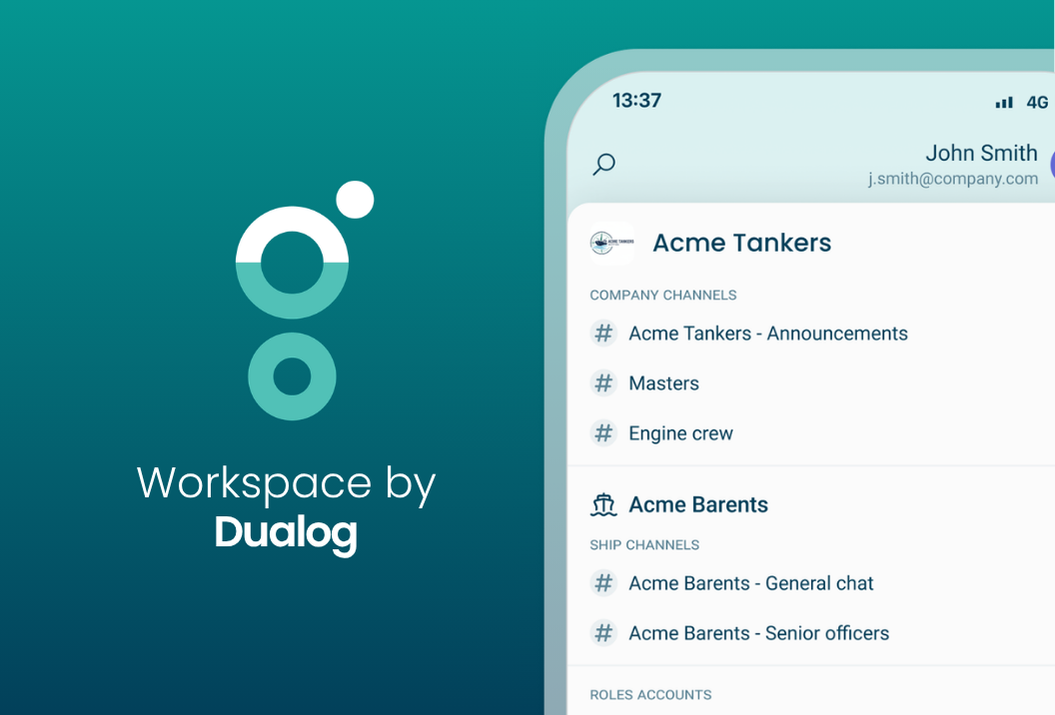
SplashTech, the shipping tech news platform by Splash Maritime Group, recently spoke with Silje Moan, Chief Commercial Officer at Dualog, about the state of artificial intelligence at sea, and what it will take before AI becomes a genuine operational tool onboard ships.
Seafarers are already experimenting with AI. What’s holding it back onboard isn’t scepticism, but trust, source control, and information overload. Solving those three is now the real work.
That is the key finding from a recent Dualog survey of around 300 seafarers and senior officers, half of them masters, with an average of more than 20 years at sea. The research was supported by 10 face-to-face interviews with seafarers and shore personnel, alongside input from customer meetings.
For Silje Moan, the most striking result was not resistance to AI, but how mature seafarers already are in their use of it.
“Seafarers are already using it. They want help solving problems,” Moan told SplashTech. “Seafarers are comfortable with technology. Half of them have experimented with AI.”
The second surprise was that connectivity is no longer the dominant frustration. Bandwidth still matters, but the problem has shifted. Crew are drowning in information, procedures, manuals, messages, and documents, and often struggle to find what they need quickly.
“We have moved from bandwidth being the problem to not being able to find information in the overload of information that exists today,” Moan said.
According to Dualog’s research, improving findability makes crew 2.5 times more likely to be satisfied. That is where Moan sees AI having one of its most immediate applications: not as a generic chatbot, but as a controlled assistant able to search approved company documentation, vessel data, and operational procedures.
The survey also highlighted the communication gap between ship and shore. Many shipping companies still rely heavily on messaging apps such as WhatsApp and Viber, where corporate control over data, access, ownership, and auditability is limited.
Moan says there is little difference between how people ashore and onboard view AI. Both want the benefit. The onboard challenge is confidence.
“Captains spend more than 50% of their time on admin work,” she said. “This can be dramatically reduced, but using approved sources of information to do this is vital.”
That point goes to the heart of shipping’s AI problem. Crews may be ready, but masters need to know the system is reliable. Shipping companies want onboard AI that draws from trusted sources, not open internet material. They also need to know who is using AI, for what purpose, and under which role-based permissions.
The likely winners, Moan argued in conversation with SplashTech, will not be the companies that simply wrap a chatbot around maritime workflows, but those that understand the realities of shipboard operations: intermittent connectivity, thousands of users, strict data control, and a need for auditability.
Looking five years ahead, she does not expect a single AI application to dominate. Instead, she sees AI changing the speed of decision-making.
“Five years from now, I expect a captain to have a knowledgeable assistant using all the vessel’s own documentation and data, something they can actually use when a situation comes up, not just search,” she said.
Onshore, fleet managers could ask complex questions across an entire fleet and get valid answers in minutes rather than weeks.
“The impact isn’t ‘AI does the job.’ It’s that the people doing the job make faster, better-informed decisions, which changes how the whole operation runs,” Moan concluded.
Our sincere thanks to the team at SplashTech and Splash Maritime Group for the thoughtful conversation and for consistently covering the topics that matter most to the maritime industry. The intersection of AI, connectivity, and operational reality onboard ships is one of the defining questions for the sector over the next five years, and the work SplashTech does to bring these conversations into the open is invaluable.
Read the original article on SplashTech.